
100 Hours of Astronomy
100 Hours of Astronomy
Gallery: 100 Hours of Astronomy
Everyone, from amateur astronomers to educators and enthusiasts, is invited to propose an event and take part in this global celebration of the night sky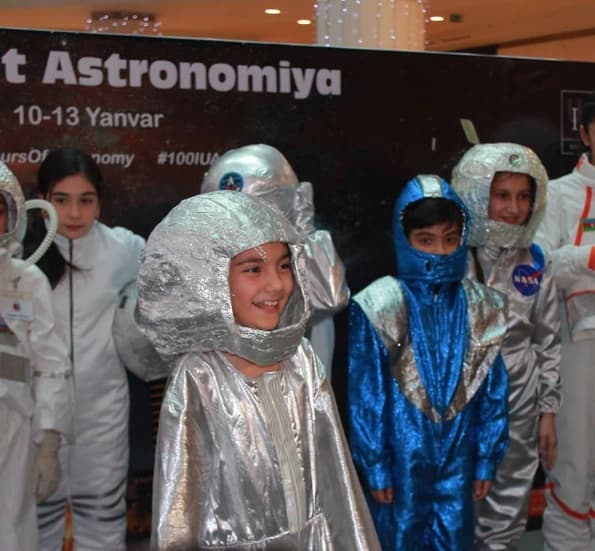
Content
- A New Perspective on the Solar System
- Science is always in motion. So is our Solar System
- How can you be part of a global event?
- 100 Hours of Astronomy Box
- Main activities and events 100 Hours of Astronomy
- Share your event with the world
- OAO Astronomy Engagement Events
- 100 Hours of Astronomy | 24 Hours of the Planetarium - 2025
A New Perspective on the Solar System
Our understanding of the Solar System has never been static. Every new observation, mission, and discovery helps us refine our knowledge, challenge old ideas, and reveal a richer and more dynamic picture of our cosmic neighbourhood.
Throughout history, our view of the Solar System has transformed dramatically, from an Earth-centred universe to a heliocentric system filled with planets, moons, asteroids, comets, and countless other worlds. More recently, space missions have reshaped our understanding of the origins of water and the building blocks of life, the nature and diversity of Solar System bodies, and humanity's place within the cosmos.
This year's 100 Hours of Astronomy celebrates the excitement of scientific discovery and invites everyone to explore the Solar System through a fresh perspective. Science is not a collection of fixed answers, it is an ongoing journey of curiosity, evidence, and discovery.
Science is always in motion. So is our Solar System
How can you be part of a global event?
Ways to Get Involved
- Download the 100 Hours 2026 resource digital box
- Plan and organise IAU outreach event between 1 - 4 October 2026.
- Attend or support a pre-existing astronomy event near you.
- Promote events on social media using #100HoursOfAstronomy2026
This year’s theme is “A New Perspective of our Solar System", but all astronomy events are welcome.
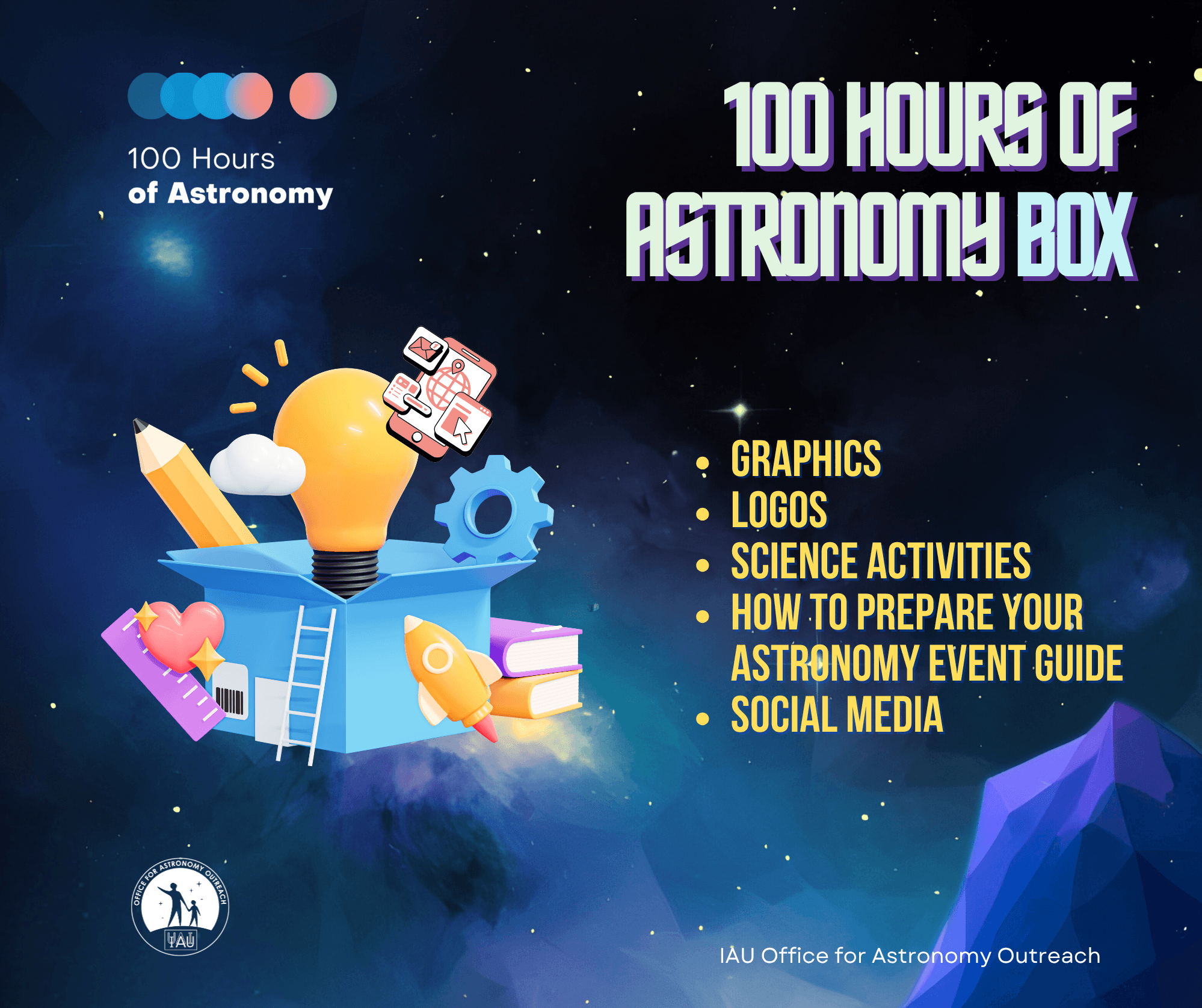
100 Hours of Astronomy Box
The 100 Hours of Astronomy Box was compiled to help you plan and promote your events for the 100 hours, and beyond. This resource includes:
- Ready-to-use designs for social media, available as a template on Canva and as AdobeIllustrator files.
- Photo and video constent forms that can be easily adapted to your event.
- Resources to suit any need: astronomy engagement tools, guides, and templates, including Canva designs, accessibility tips, educational materials, and links to key resources.
- And more! This is an evolving resource. Check back here for new and exciting content!
Main activities and events 100 Hours of Astronomy
Mission: Mars. Unravelling the mysteries of the Solar System with MMX
Masaki Fujimoto - Director General JAXA-ISAS
Tomohiro Usui - Professor JAXA-ISAS
Elizabeth Tasker - Associate Professor Jaxa-ISAS
Simon Tardivel - Systems Engineer, Idefix CNES
Date: October 1
Time: 12:00 UTC
Diving Into the Mysteries of Ocean Worlds in our Solar System with Remote Observations: It Takes a Fleet!
Dr. Stefanie Milam is a Planetary Scientist at NASA’s Goddard Space Flight Center and the JWST Project Scientist for Policy and Science Community. She is an expert in spectroscopy, observations, and laboratory astrophysics with a focus on studies of small bodies in the solar system (comets and interstellar objects [ISOs]). Milam maintains a renowned observational program and research group employing telescopes in and out of this world to routinely observe and characterize these objects. She is interested in learning how these icy relics created during planet formation tell us what ingredients were present during that period and how that influenced the diverse population of planets in our solar system and perhaps even habitability on Earth. She also has a laboratory dedicated to simulating cometary ices and study the chemistry that occurs from processing on a journey around the sun and uses these experiments to interpret observational data from missions that observe these bodies
Date: October 2
Time: 14:00 UTC
YouTube Live: https://www.youtube.com/live/nJL_XCyA_As?si=hBz3h9GPnWRm0bSC
Pluto: From discovery to rediscovery
100 Hours / World Space Week hand-off
Participants:
Dr. Kelly Blumenthal - IAU Office for Astronomy Outreach
Dr. Alma Okpalefe - World Space Week
Date: October 4
Time: 9 AM - UTC
Join: OAO YouTube Live: https://www.youtube.com/live/ID_QLEiiu6k?si=XciieENouDM46Ggf
Share your event with the world
We encourage you to share your events and participate in this year’s 100 Hours of Astronomy! If your event is open to the public, please leave enough information for people to get involved—both in person and online!
Help us spread the excitement of 100 Hours of Astronomy by sharing your event on social media! Use the official hashtags so your activity can reach a global audience.
Copy the hashtags and include them in your posts, photos, or livestreams: #100HoursOfAstronomy, #IAUoutreach
OAO Astronomy Engagement Events
100 Hours of Astronomy | 24 Hours of the Planetarium - 2025
More Information
All events must respect the general guidelines of the IAU Global Project and Themes, which promote the key role of astronomy for the betterment of science and society through collaboration and with a spirit of respect, tolerance, and peace.
If you need to change your events already on the calendar, please email the IAU Office for Astronomy Outreach Team via public@...Click to show with the subject line “100 Hours of Astronomy Calendar 2026 - Update”.If you cannot submit through this form, please email the IAU Office for Astronomy Outreach team via public@...Click to show with the subject line “100 Hours of Astronomy Calendar 2026 - Update”.